How to read an EU regulation without a law degree
Short answer
Read backwards: start with the scope article and the definitions, then the annexes, and only then the substantive requirements. Ninety percent of wasted certification money comes from reading Article 5 before Article 1.
Does this apply to you?
| What you are trying to find out | Where to look | Usually the wrong place |
|---|---|---|
| Whether the rule covers your product | Article 1 / Article 2 (scope) | The requirement articles |
| What “placing on the market” means for your case | Definitions article | Recitals |
| Which technical detail applies to your variant | Annexes | The main text |
| Who is responsible | Definitions + the “obligations of economic operators” chapter | The recitals |
| When it takes effect | The final articles (entry into force) | The title page |
What the text actually says
Regulations are structured in a fixed order, and that order tells you how to read them:
“This Regulation applies to [products] … It shall not apply to [excluded products].” — the shape of a typical Article 1
“‘manufacturer’ means any natural or legal person who … places the product on the market under his own name or trademark” — the shape of a typical definitions article
The single most expensive word in EU product law is “manufacturer”. If you put your own brand on a part made by someone else, you take on the manufacturer’s obligations — full stop. That one definition decides whether you need your own technical file, your own declaration, and your own liability cover.
What to do
- Open the regulation on EUR-Lex in the official language you read best. The English version is authoritative for content but the structure is identical across languages.
- Read Article 1 and Article 2 twice. Note every exclusion. Exclusions are where Chinese exporters usually find they were never in scope — or, less often, that they are.
- Read the definitions. Copy out every term that appears in your product’s description. “Component”, “interchangeable part”, “separate technical unit” all have defined meanings.
- Jump to the annex that matches your product family. Annexes are the part that a test lab actually reads.
- Only then read the obligations chapter. By this point you know which obligations apply to you, so the chapter is short instead of overwhelming.
- Write down the version and date you read. Regulations get amended; a claim without a date is not a claim.
Where exporters get it wrong
- Reading a summary instead of the text. Summaries compress exclusions away, and the exclusion is usually the answer.
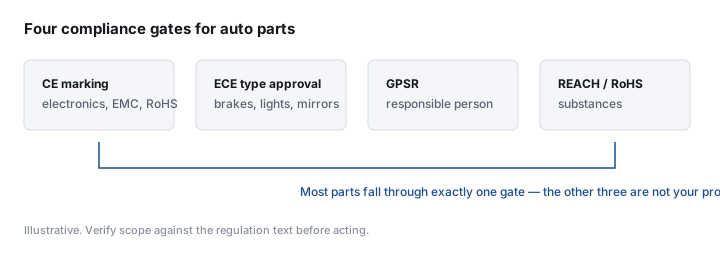
- Assuming “CE” is a single law. It is not a law, it is a marking produced by several different directives and regulations, each with its own scope.
- Confusing type-approval with CE. Automotive parts subject to UN type-approval carry an E-mark; that is a different regime from CE marking, and a part is normally not both.
- Ignoring the “economic operator” definitions. Importer, distributor and fulfilment service provider each carry duties; who you are changes what you must hold.
- Treating the date at the top of a web page as the version. Only the Official Journal version counts.
Version and dates
| Item | Value |
|---|---|
| Regulation | Method article — no single instrument |
| Applies from | n/a |
| Last checked | 16 November 2026 |
| Official source | EUR-Lex · eCFR · UK Legislation |
Scope. This article summarises publicly available regulatory texts as of Method — no single regulation applies. Requirements change; verify against the official source before acting.
Not legal advice. This is an information service, not a legal opinion, and it does not create any professional relationship. For decisions specific to your product, consult a qualified professional or the competent authority.
Sources. EUR-Lex, UK Legislation, eCFR and UNECE regulation texts, linked inline where applicable.